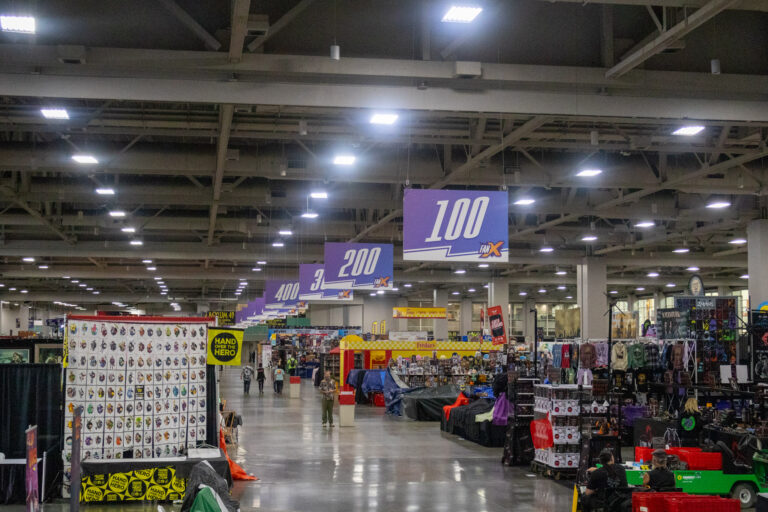
Most event planning happens at floor level: booth layouts, registration tables, stages, seating. But some of the most valuable space in any expo hall is 20 to 40 feet overhead, and it often goes unused.
Hanging signs and banners turn that empty air into something that works for the event. Overhead signage guides attendees through the space, welcomes them at the door, gives sponsors premium visibility and makes a convention hall feel like your event instead of a concrete box. Whether you’re producing a trade show, a conference, a community event or a gala, here’s how overhead signage earns its place.
Once a hall fills with booths, pipe and drape and people, attendees lose their sightlines. Floor-level signs get blocked, and a printed map only helps if people know where they’re standing. Overhead signs stay visible above the crowd from almost anywhere in the room.
A show-wide hanging sign program can include:
Good wayfinding means less time lost and fewer frustrated attendees. It also means more traffic reaching the back corners of the hall, which is something exhibitors in those spaces will thank you for. For events that serve the public, clear overhead signs help guests find the services they came for quickly and with less stress.
An entrance banner is the first thing attendees see, and it does more than look good. It confirms they’re in the right place, which matters in a large venue hosting several events at once. It builds excitement as people arrive, and it gives everyone a natural backdrop for photos they’ll share online.
Large banners over hall entrances, lobbies, concourses and registration areas carry the event’s name, theme and key sponsors in a way no floor sign can match. They turn a generic convention center entrance into the front door of your event.
For organizers, every overhead hang point is a potential sponsorship. Sponsor banners over entrances, main aisles, stages, food courts or registration get seen by nearly every attendee, many times over the course of the show.
That makes overhead signage one of the easier ways to add sponsor value or bring in new revenue. You can package it in tiers, such as the main entrance banner for a title sponsor, aisle signs for supporting sponsors and amenity signs (“Lounge presented by…”) for smaller partners. Because sponsors can see and photograph their placement, it’s also easy for them to justify the spend and come back next year.
Convention halls are big, gray and built to be neutral. Overhead signage is one of the most efficient ways to change that. A consistent set of hanging signs in your event’s colors and graphics ties the whole room together and makes it feel designed, not just filled.
It also frees up the floor. Every sign that hangs is one less banner stand, easel or tower taking up space in aisles, at intersections or near entrances. That means more room for people, cleaner sightlines, fewer trip hazards and more sellable booth space.
Individual exhibitors benefit too. A sign hanging over a booth can be seen from across the hall, makes the space look larger than its footprint, and gives attendees a simple landmark (“look for the big blue sign”). For organizers, offering hanging signs in the exhibitor services kit is a useful upgrade for exhibitors and an easy add-on to promote.
Hanging one sign is simple. Hanging dozens across a hall takes planning. A few things make it go smoothly:
Modern Expo & Events handles overhead signage at every scale: show-wide wayfinding across entire expo halls, entrance and sponsor banners, and individual exhibitor booth signs. Our crew plans the placement, brings the lifts and handles the install and teardown, so your signs are up and looking sharp before the doors open.
Planning an event in Salt Lake? Contact us for a quote and let’s put the space overhead to work.
Ready to get started? Contact us today to talk with our team about your upcoming expo or trade show, and see how we can help you deliver an event your attendees and exhibitors will remember.